
OpenTofu infrastructure
Managing infrastructure with OpenTofu: SQLite HTTP state backend, plan diffs, CEL policies, and sealed outputs.
exocomp provides native lifecycle management for OpenTofu (opentofu) configurations, combining an embedded HTTP state backend with granular plan-diff rendering and safety guardrails.
The SQLite HTTP state backend
exocomp implements OpenTofu's HTTP state backend directly inside exocompd backed by the local SQLite database (Decision 0004):
- No external S3 or MinIO required: Eliminates the conditional-write/consistency bugs of self-hosted object stores.
- Automatic version history: Every state update is recorded with full rollback history.
- State locking: Prevents concurrent modifications across jobs.
Configure the backend in your OpenTofu configuration (or run exocomp workspace add <name> --state-only to generate the exact ready-to-paste block and bearer token):
terraform {
  backend "http" {
    address        = "http://127.0.0.1:8543/api/v1/tf/state/prod"
    lock_address   = "http://127.0.0.1:8543/api/v1/tf/state/prod"
    unlock_address = "http://127.0.0.1:8543/api/v1/tf/state/prod"
    lock_method    = "LOCK"
    unlock_method  = "UNLOCK"
  }
}
Running plans and applies
-
Register the workspace and trigger a plan:
exocomp workspace add prod --dir terraform/dns
exocomp workspace plan prod
The plan is executed inside the sandbox, parsed, classified, and sealed into SQLite as an immutable plan artifact.
-
Inspect the plan diff: In the Web UI, the workspace view renders high-contrast, structured plan diffs:
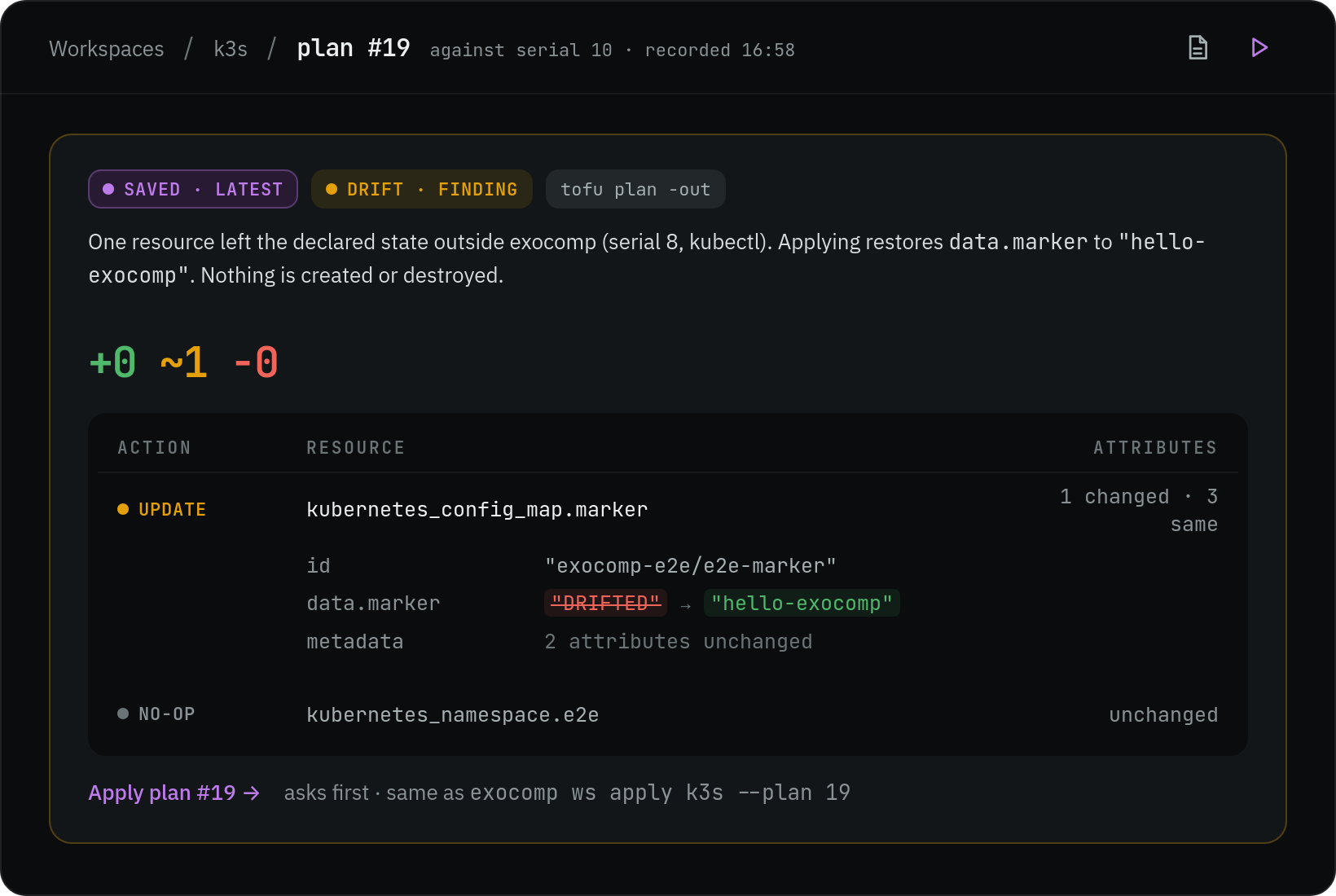
The diff engine implements strict formatting invariants:
- Top-level non-server-set keys are counted precisely (
N of K keys changed). - Server-set fields (such as
uidandresource_version) are filtered. - Sensitive values are automatically redacted (
[redacted · secret]).
- Top-level non-server-set keys are counted precisely (
-
Apply the plan:
exocomp workspace apply prodIf configured with an approval policy or triggered via webhook, the apply pauses at an approval gate until confirmed via Web UI, TUI, or mobile push notification.
Gating plans with CEL policies
You can prevent destructive actions (e.g. dropping a production database or destroying more than 5 resources) using Common Expression Language (CEL) policies:
# .exocomp/policies/safe-apply.yml
name: max-destructions
rule: "plan.resource_changes.filter(r, 'delete' in r.change.actions).size() < 5"
action: deny
message: "Refusing plan: destroys more than 4 resources"
If a plan violates a CEL policy, exocomp seals the plan with a status of refused and rejects any attempt to apply it.
Binding sealed outputs
When an OpenTofu workspace exports a sensitive output (such as an admin token or generated database password), mark it as sensitive:
output "db_password" {
  value     = random_password.db.result
  sensitive = true
}
exocomp encrypts this value directly into the age secrets envelope as a sealed run-secret. Subsequent Ansible playbooks targeting the workspace can consume the output as an environment variable ($DB_PASSWORD) without exposing secrets in logs or state files.